


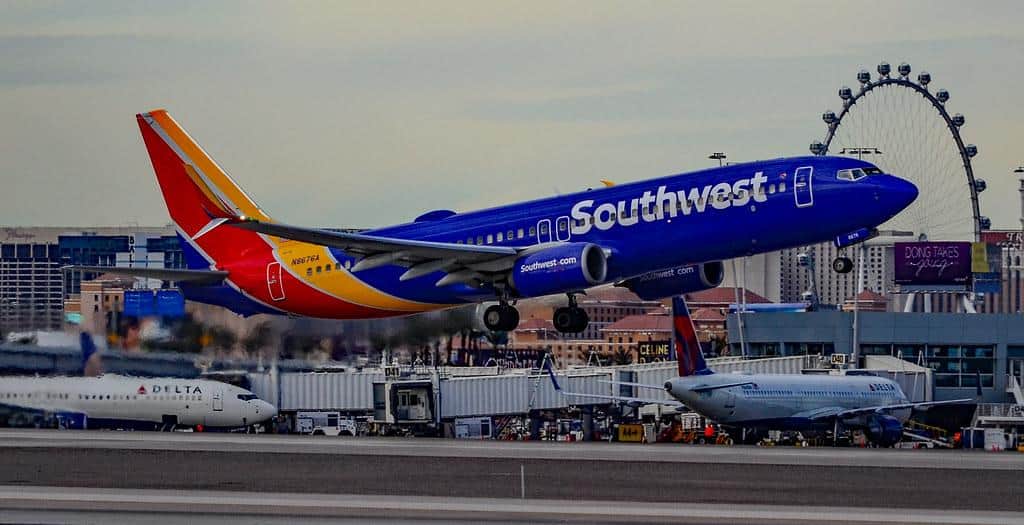
Southwest Airlines (NYSE:LUV | LUV Price Prediction) entered 2026 with its most sweeping operational overhaul in the carrier’s history, only to see shares slide 22% over the past month as a surge in oil prices threatens the earnings thesis. Southwest’s Reddit sentiment score sits at 32 out of 100, firmly bearish, and has been deteriorating since late March.
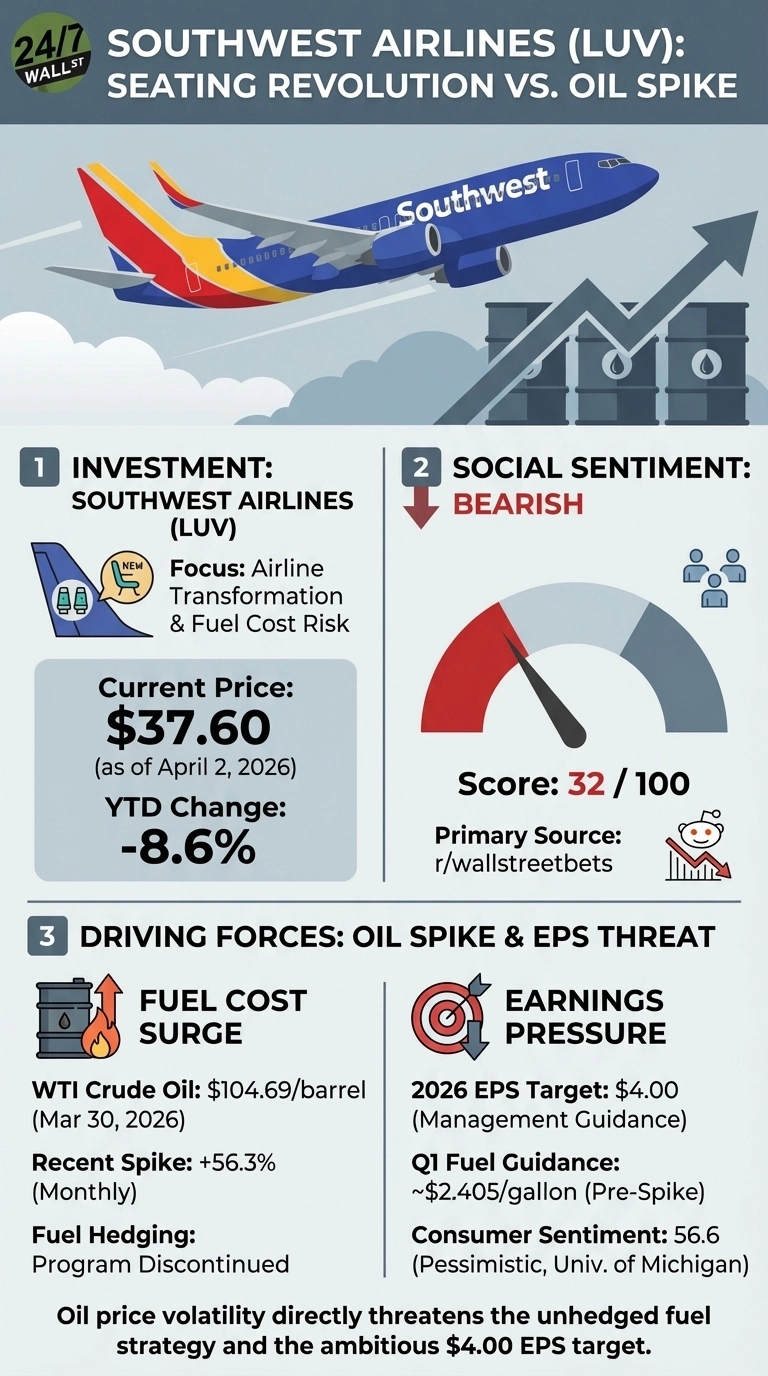
WTI crude reached $104.69 per barrel as of March 30, up 56.3% from a month earlier, driven by the closure of the Strait of Hormuz following the U.S.-Iran conflict, which CNBC described as “the biggest oil supply disruption in history.” Jet fuel costs have risen roughly 106% versus a month ago, per the International Air Transport Association. Southwest guided Q1 2026 fuel costs at roughly $2.405 per gallon, a figure that looks increasingly disconnected from current market reality.
Southwest terminated its fuel hedging program in early 2025. With WTI near a 12-month high, that decision has drawn criticism from analysts and investors. Goldman Sachs cut its price target to $30 and maintained a sell rating; TD Cowen lowered its target to $55 while maintaining a buy rating. Shares trade around $37.60, down 8.6% year to date.
Reddit Turns Bearish on Southwest’s Unhedged Fuel Exposure
Discussion is concentrated in r/wallstreetbets, with sentiment scores dropping to 18 (very bearish) on April 1 before recovering slightly to 32 by April 3. Peak engagement came on Thursday, April 2 at 3pm ET, when a post drew 17 comments. One thread on r/wallstreetbets titled Rolled USO, Trimmed BNO, Puts on LUV. Oil Yolo. included a note from the author that “global inventories have shrunk dramatically and we could see major shortages going into April.”
Rolled USO, Trimmed BNO, Puts on LUV. Oil Yolo.
by u/unknown in wallstreetbets
The bearish case centers on three problems: Southwest discontinued its fuel hedging program in early 2025, leaving it fully exposed to spot prices, with jet fuel up roughly 106% and directly threatening the $4.00 EPS target for 2026. Consumer sentiment stands at 56.6 on the University of Michigan index, below the 60 level associated with recessionary conditions, which is pressuring willingness to pay for new ancillary fees and premium seating. Southwest’s assigned-seating rollout, which went live as of January 27, 2026, has drawn mixed reactions and negative press coverage.
Southwest’s $4.00 EPS Target Faces a Narrowing Path
CEO Bob Jordan stated after Q4 2025 earnings that “Southwest closed 2025 with strong momentum. Last year, we implemented the most ambitious transformation in Company history, including bag fees, basic economy fares, assigned and extra legroom seating, Rapid Rewards program optimization, online distribution expansion, and free Wi-Fi for loyalty members.” The airline returned $2.9 billion to shareholders in 2025, operating cash flow rose 298.7% year over year, and Q4 2025 operating income grew 40.65%. Management targets roughly $4.3 billion in initiative-driven EBIT contribution for 2026, up from $1.8 billion in 2025.
The $4.00 EPS target was built on a fuel cost assumption of roughly $2.405 per gallon for Q1 2026, set before the Hormuz closure sent crude to $104.69 per barrel. Southwest also carries $209 million in remaining hedge premium costs through 2027. Insider buying remains net positive, and 11 analysts rate the stock a buy against 5 sells, with a consensus target of $45.56. The composite sentiment score of 38.87 and model-based price target of $29.71 reflect the gap between management’s fundamental story and current market pricing.
Management guided Q1 adjusted EPS of at least $0.45 and RASM growth of at least 9.5% year over year, but those figures predate the full impact of the oil spike. The Q1 2026 earnings report will be the next hard data point on whether the $4.00 full-year target remains credible.






 Top Gaining Stocks
 Top Losing Stocks