


AMD (NASDAQ: AMD | AMD Price Prediction) and NVIDIA (NASDAQ: NVDA) both just delivered the kind of quarters that make me grin at my screen. AMD posted $10.27 billion in Q4 revenue, up 34.1% YoY, while NVIDIA stunned with $68.1 billion, up 73.2%. Different scales, different stories, and in my view, very different setups for the next 12 months.
Two Monster Quarters, One Smaller Base
AMD’s Data Center segment hit $5.38 billion, up 39%, fueled by EPYC server CPUs and Instinct GPUs. Client revenue jumped 34% to $3.097 billion as Ryzen kept eating into capacity-constrained Intel. Lisa Su called 2025 “a defining year”, and the $2.08 billion record free cash flow backs that up.
NVIDIA, meanwhile, runs a different beast. Data Center alone delivered $62.3 billion, or 91.5% of total revenue, with Networking surging 263% YoY. Jensen Huang says enterprise agent adoption is skyrocketing. I believe him. I just think the bar is now astronomical.
| Lens | AMD | NVIDIA |
| Market cap | ~$567B | ~$5.06T |
| Q4 revenue growth | +34.1% | +73.2% |
| Guided gross margin | ~55% | ~75% |
| Revenue concentration | Diversified across 4 segments | 91.5% Data Center |
Why the Alpha Lives at AMD
Here is my call: AMD has more relative upside than NVIDIA over the next twelve months. Here are four reasons why:
- First, the math of small bases. AMD shares are already up 268.17% over the past year, yet NVIDIA’s 95.73% climb came on a base nearly nine times larger. Doubling AMD is achievable. Doubling a $5 trillion company is a different ask.
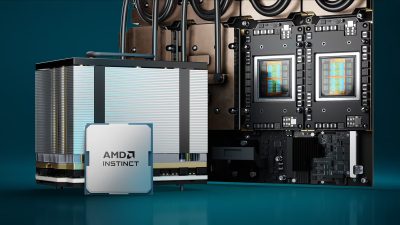
- Second, hyperscaler traction is finally real. The OpenAI 6 GW MI450 deal, Oracle’s 27,000-node MI355X cluster, and the Helios rack-scale platform show AMD is no longer a curiosity in AI training.
- Third, NVIDIA’s concentration cuts both ways. Q1 FY27 guidance of $78 billion explicitly excludes China Data Center compute, and $95.2 billion in supply commitments is a lot of rope.
- Fourth, custom silicon. Google’s TPU and Amazon’s Trainium chip away at NVIDIA’s moat far more than at AMD’s, because AMD is the merchant alternative customers actually want diversified into.
The Next 12 Months Hinge on MI450
I will be watching the H2 2026 MI450 1-GW rollout, EPYC Venice ramp, and whether AMD’s 85% Polymarket-implied earnings beat probability for May 5 actually lands. You should watch NVIDIA’s China commentary and Rubin transition cadence.
Why I Lean AMD for the Alpha Hunt
NVIDIA is the better business. AMD, I think, has the more interesting 12-month setup. With NVIDIA’s analyst target at $268.61 versus its $209.64 price, the upside is real but priced. AMD’s P/E of 133 is rich, yet the surprise potential is fatter. For investors researching stability and full-stack dominance, NVIDIA’s profile fits the bill. For those researching the potential for a meatier delta, my read says AMD’s setup looks hotter for longer.









 Top Gaining Stocks
 Top Losing Stocks