


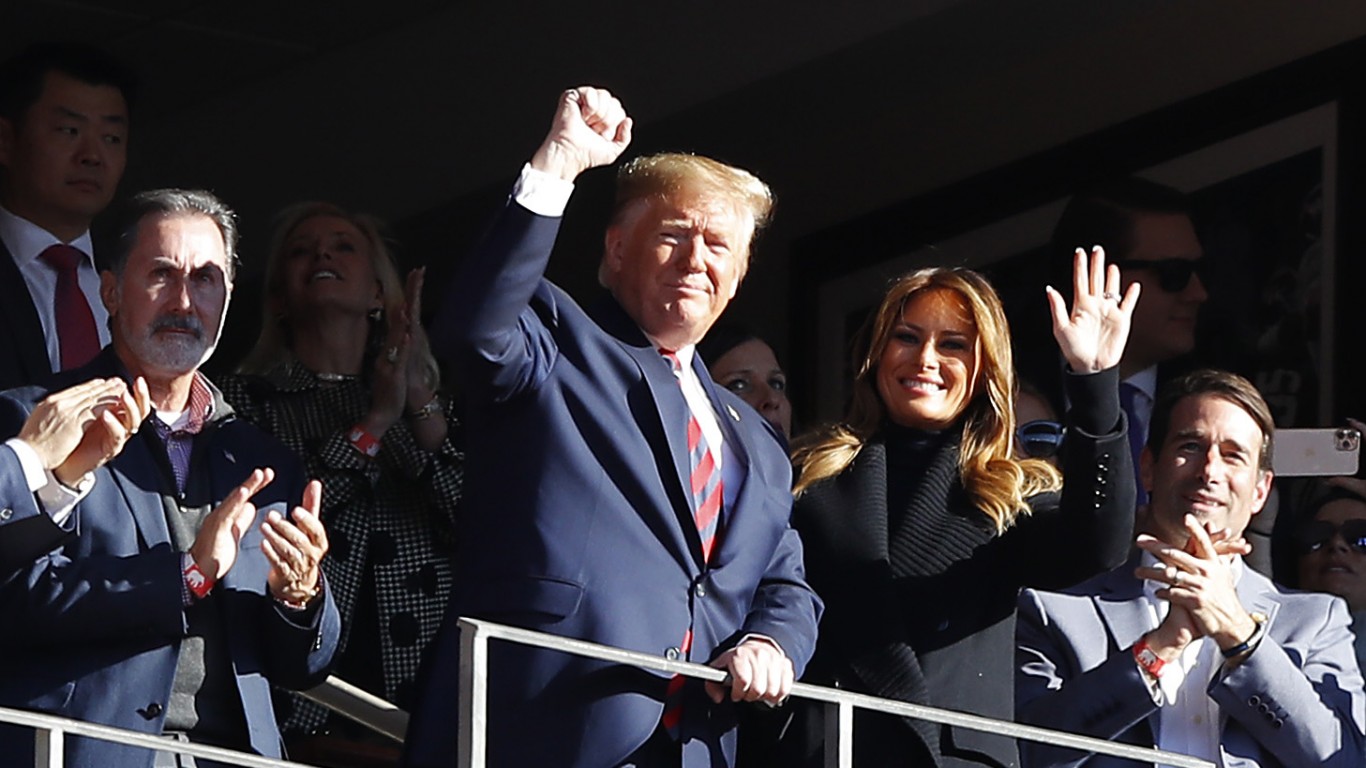
The stock market entered 2026 with sky-high expectations. After all, investors had just watched the S&P 500 deliver one of the strongest first-year presidential performances in modern history under President Donald Trump’s second term. Momentum was everywhere — artificial intelligence spending surged, corporate earnings expanded, and enthusiasm around deregulation pushed stocks higher across nearly every sector. But markets have a habit of humbling investors the moment optimism becomes consensus.
Now, with the S&P 500 up just 6% year to date, Wall Street is confronting a tougher question: Was Trump’s historic first-year rally a launching pad, or the peak of the cycle?
Let’s look at what changed.
Trump’s First-Year Rally Put Him Near the Top of Market History
According to Bloomberg and the Center for Research in Security Prices data, Trump’s first year back in office produced the second-highest annualized stock market return of any president over the last 129 years. Only President Calvin Coolidge posted stronger comparable gains during the roaring 1920s.
That’s rare territory.
The S&P 500 finished 2025 up more than 28%, powered by a narrow group of mega-cap technology companies and accelerating AI infrastructure spending. Investors poured capital into semiconductor makers, cloud computing firms, and energy producers supplying the electricity needed for expanding data centers.
Here’s what drove much of the rally:
| Catalyst | 2025 Impact |
| AI infrastructure spending | Hyperscalers projected over $340 billion in combined capital expenditures |
| Corporate tax optimism | Investors anticipated a friendlier regulatory environment |
| Falling inflation | Consumer Price Index growth slowed near 2.5% by late 2025 |
| Federal Reserve rate-cut hopes | Treasury yields declined through much of the second half |
Surprisingly, the rally became increasingly concentrated. According to S&P Dow Jones Indices data, the top 10 companies in the S&P 500 accounted for more than 38% of the index’s total market capitalization by December 2025.
That says just a handful of stocks did much of the heavy lifting.
A Different Set of Problems Confronts 2026
This year started with investors expecting another runaway bull market. Instead, markets ran into a wall of economic reality.
The Federal Reserve has remained cautious on interest rates after inflation proved stickier than expected in housing, insurance, and energy prices. According to the Bureau of Labor Statistics, core inflation has hovered closer to 3.5% in early 2026 rather than falling toward the Fed’s 2% target. That matters because valuations entered the year stretched.
At the start of 2026, the S&P 500 traded at roughly 24 times forward earnings, according to FactSet. That was well above the index’s 10-year average multiple of about 19.
When valuations get that elevated, companies have to keep delivering near-perfect earnings growth to justify stock prices. Some still are. Many are not.
Here’s how a few major sectors have performed year to date:
| Sector | 2026 YTD Return |
| Energy | +30.7% |
| Utilities | +9.0% |
| Technology | +8.1% |
| Consumer Discretionary | +1.8% |
| Financials | -5.3% |
S&P 500 sector performance.
Energy’s leadership surprises many investors because oil prices spent much of the last decade struggling. But tighter global supply conditions and rising electricity demand tied to AI data centers have revived the sector.
Meanwhile, several former market leaders stumbled after posting slower revenue growth. Investors discovered that paying 35 to 40 times earnings leaves little room for disappointment.
Granted, a 6% gain for the S&P 500 is hardly a crisis. Historically, that’s still a healthy return over four months. The problem is expectations became detached from reality after 2025’s extraordinary run.
The Market Is Shifting From Momentum to Fundamentals
Perhaps the biggest change in 2026 is that investors are becoming selective again.
Last year rewarded almost any company connected to AI. This year, markets are asking tougher questions:
- Can profits support spending?
- Are margins expanding?
- Is free cash flow actually growing?
That’s a healthier environment long term, even if it feels less exciting day to day. The difference is, investors are no longer willing to pay any price for growth.
That shift also explains why defensive sectors like utilities have outperformed. Companies generating stable cash flow suddenly look attractive again when interest rates stay elevated longer than expected.
Key Takeaway
In short, Trump’s first year produced one of the strongest presidential market performances investors have seen in more than a century. But 2026 is proving that historic rallies rarely repeat in a straight line. That doesn’t mean the bull market is over.
Corporate earnings are still growing. The labor market remains resilient. AI investment continues expanding at a rapid pace. According to Goldman Sachs estimates released in April, global AI infrastructure spending could surpass $2 trillion over the next decade.
Still, markets appear to be transitioning from easy optimism toward disciplined stock picking. That may actually benefit smart investors most. Speculative momentum can create quick gains, but fundamentally strong businesses generating real cash flow tend to win over longer periods.
And in any case, a slower market doesn’t necessarily mean a weaker one. Sometimes it just means investors finally have to think again.










 Top Gaining Stocks
 Top Losing Stocks