
The Roth Tipping Point: Why 86% of Companies Just Changed the Tax Game

Photo of David Beren
By David Beren Published

Quick Read

  • Vanguard (VGU): 86% of 401(k) plans now offer Roth options, up from 74% in 2020, with 18% of participants electing Roth in 2024, marking an all-time high and reflecting a fundamental shift away from traditional pre-tax retirement savings.

  • Workers are choosing Roth contributions over traditional 401(k)s as tax rates are expected to rise, driven by plan design changes, automatic enrollment expansion, and younger, higher-income participants seeking tax diversification and lower current tax brackets.

This post may contain links from our sponsors and affiliates, and Flywheel Publishing may receive compensation for actions taken through them.
The Roth Tipping Point: Why 86% of Companies Just Changed the Tax Game

© bangoland / Shutterstock.com

The single biggest design shift inside the American 401(k) this decade is about taxes, more than fees, target-date funds, or auto-escalation. According to Vanguard’s 2025 How America Saves report, 86% of plans now offer a Roth contribution option, up from 74% in 2020. Among participants whose plans offered it, 18% elected the Roth option in 2024, an all-time high, up from 12% in 2019. The traditional pre-tax 401(k) is no longer the only default.
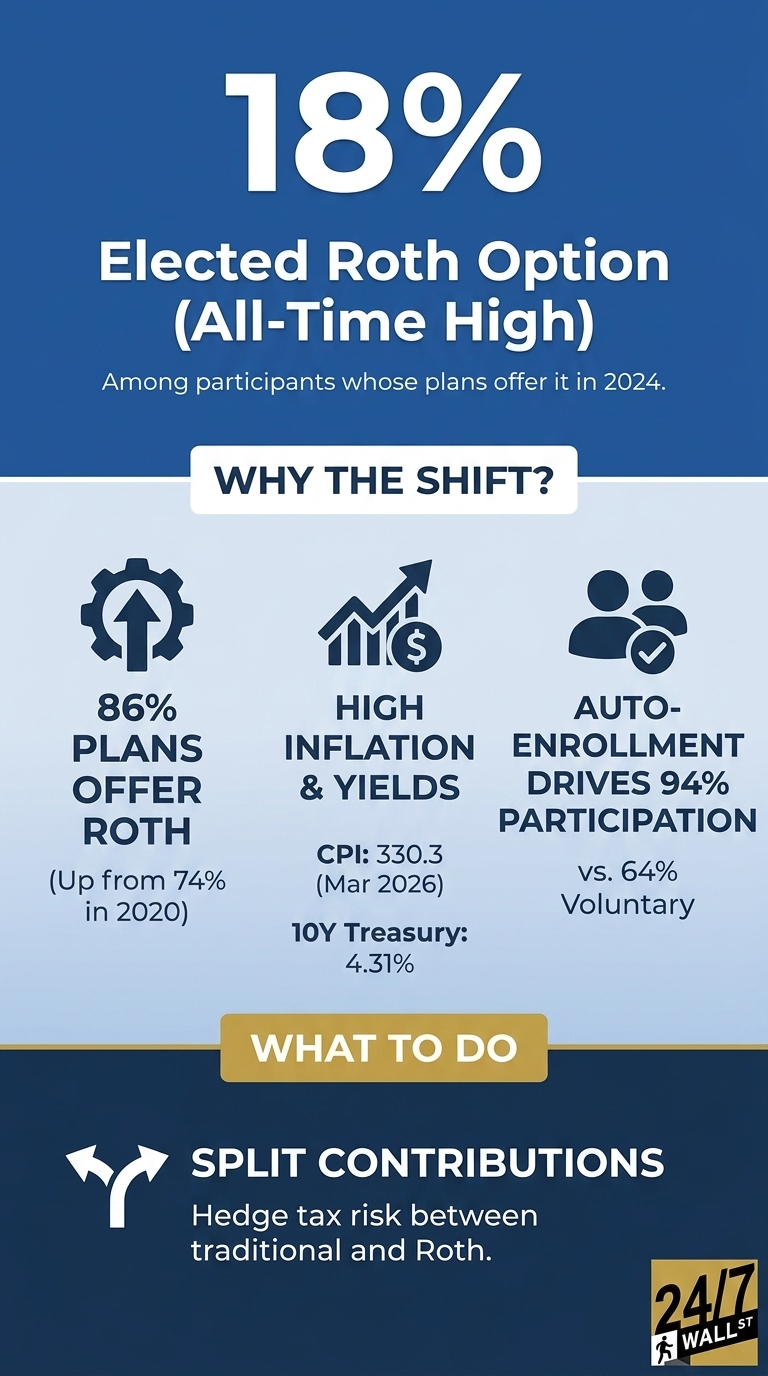
An infographic titled
24/7 Wall St.
This infographic highlights the rise of Roth option elections to an all-time high of 18% in 2024 and explores the reasons behind this shift, including increased plan offerings, high inflation, and auto-enrollment. It also suggests splitting contributions as a strategy.

What “Rothification” Actually Means

A traditional 401(k) lets workers defer income taxes today and pay them in retirement when withdrawals begin. A Roth 401(k) flips that math. Contributions are made with after-tax dollars, and qualified withdrawals, including all investment growth, come out tax-free. The bet is simple: pay a known tax rate now, or pay an unknown future rate later.
 
Vanguard’s data captures how quickly that bet has shifted. 96% of participants in larger plans are now offered Roth as a feature, making it close to a universal option for workers at mid-size and large employers. The growth in adoption, from 12% of participants in 2019 to 18% in 2024, reflects both broader access and a changing read on where future tax rates are headed.

Why the Tax Calculus Is Changing Now

The plan data supplies part of the context. Hardship withdrawals hit 4.8% of participants in 2024, up from 3.6% in 2023, suggesting household balance sheets are strained. At the same time, the average participant deferral rate reached an all-time high of 7.7% in 2024, with a median of 6.8%. Total contribution rates, including employer match, reached 12.0%. When workers are already stretching to save, the tax treatment of those dollars becomes a sharper question.

Plan Design Did Most of the Work

The Roth shift happened largely because plan sponsors changed the menu. 86% of Vanguard plans now offer Roth, up from 74% in 2020. Among plans with at least 5,000 participants, 95% offer the feature. Automatic enrollment also expanded the pool. 61% of plans now auto-enroll, up from 10% in 2006, and auto-enrolled employees participate at 94% versus 64% for voluntary plans. When Roth appears as a contribution type alongside these defaults, more participants encounter it as a live choice rather than a buried menu option.

Who Tends to Choose Roth

The 18% who elect Roth skew toward younger and higher-income participants, according to Vanguard’s demographic breakdown. Among participants under 25, 17% chose Roth if offered. In the $100,000 to $149,999 income bracket, 24% elected the option, as did 21% of those earning $150,000 or more. The pattern suggests workers who expect their current tax bracket to be lower than their future one, or who simply want tax diversification, are driving the adoption.

What to Watch Next

  • Roth availability now reaches 86% of Vanguard plans, with the option appearing under contribution type in most enrollment portals.
  • Many plans allow a split between traditional and Roth contributions, which lets participants hedge the tax-rate question without an all-or-nothing decision.
  • The 12.0% total contribution average serves as a benchmark for deferral rates relative to the typical employer match. 
Photo of David Beren
About the Author David Beren →

David Beren has been a Flywheel Publishing contributor since 2022. Writing for 24/7 Wall St. since 2023, David loves to write about topics of all shapes and sizes. As a technology expert, David focuses heavily on consumer electronics brands, automobiles, and general technology. He has previously written for LifeWire, formerly About.com. As a part-time freelance writer, David’s “day job” has been working on and leading social media for multiple Fortune 100 brands. David loves the flexibility of this field and its ability to reach customers exactly where they like to spend their time. Additionally, David previously published his own blog, TmoNews.com, which reached 3 million readers in its first year. In addition to freelance and social media work, David loves to spend time with his family and children and relive the glory days of video game consoles by playing any retro game console he can get his hands on.

Featured Reads

Our top personal finance-related articles today. Your wallet will thank you later.

Continue Reading

Top Gaining Stocks

CBOE Vol: 1,568,143
PSKY Vol: 12,285,993
STX Vol: 7,378,346
ORCL Vol: 26,317,675
DDOG Vol: 6,247,779

Top Losing Stocks

LKQ
LKQ Vol: 4,367,433
CLX Vol: 13,260,523
SYK Vol: 4,519,455
MHK Vol: 1,859,865
AMGN Vol: 3,818,618