


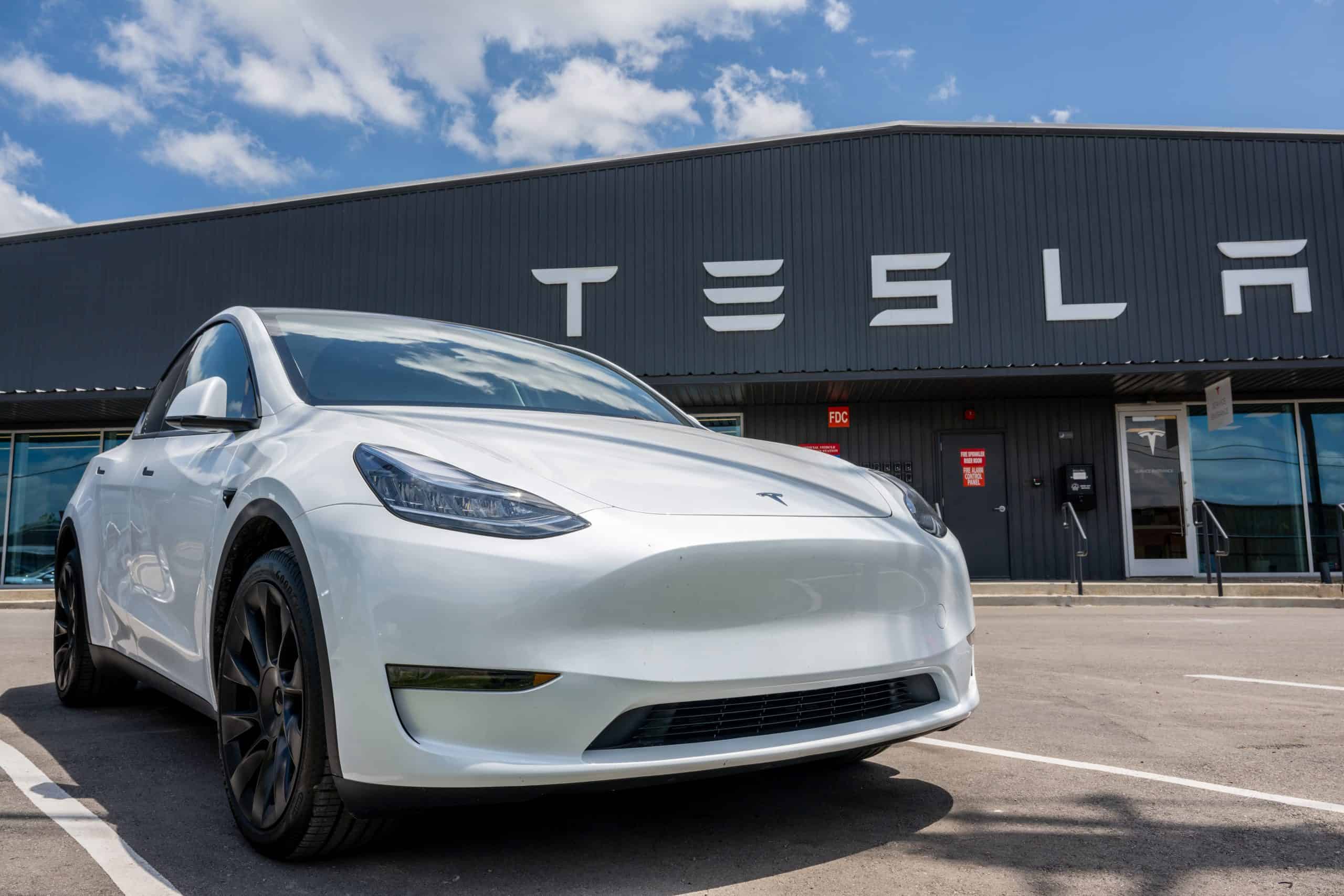
Tesla (NASDAQ:TSLA | TSLA Price Prediction) stock is slipping 3% in Thursday trading, with shares hovering around $382 as of midday. That puts TSLA down 15% year-to-date from its $449.72 close on December 31. Today’s session is not a simple story.
Three distinct catalysts are hitting the stock simultaneously, and they are not pointing in the same direction. Regulators are tightening the screws on Full Self-Driving (FSD), Tesla is making a bold semiconductor bet, and a longtime competitive advantage is quietly getting shared with rivals. Here’s how each piece fits together.
NHTSA Turns Up the Heat on FSD
The U.S. auto safety regulator has intensified its investigation into Tesla’s FSD system following nine crashes, including one fatality. The probe is now at the engineering analysis stage, with the National Highway Traffic Safety Administration (NHTSA) focusing on whether FSD can adequately detect degraded road conditions and warn drivers in time. The investigation covers approximately 3.2 million Tesla vehicles.
The timing is painful. Tesla’s entire long-term bull case rests on autonomous driving, robotaxi revenue, and eventually a fleet of self-driving cars generating income around the clock. A deepening federal investigation does not kill that thesis, but it adds friction, delays, and headline risk at exactly the moment Tesla needs regulatory goodwill to expand its robotaxi rollout beyond Austin.
Prediction markets reflect that uncertainty. Polymarket currently puts the probability of Tesla launching robotaxis in California by June 30 at just 13%. That’s not a vote of confidence in near-term autonomous expansion, and the NHTSA escalation is not helping that number move in the right direction.
Terafab: The Long Game in Semiconductors
On the bullish side of the ledger, Tesla launched its Terafab semiconductor unit, which is targeting production of hundreds of billions of custom chips annually. The ambition here is enormous: vertical integration of the silicon powering Tesla’s AI training, FSD inference, and eventually the Optimus humanoid robot. If Tesla can build chips at scale internally, it reduces dependency on third-party suppliers and potentially unlocks margins that no other automaker can touch.
We covered the full Terafab story in depth earlier today. This isn’t just a manufacturing announcement; rather, it’s Tesla drawing a line between itself and every other EV company that will never build its own silicon.
The complication is that chip fabrication is brutally capital-intensive. Tesla is already navigating a year in which CEO Elon Musk indicated the company might finalize design for its next-generation AI6 chips by December, with Samsung expected to handle volume production using a 2-nanometer process by late 2027. Terafab is a long-horizon bet, and the market tends to discount long-horizon bets when near-term delivery numbers are under pressure.
Stellantis and the Supercharger Dilemma
Stellantis (NYSE:STLA) is expanding access to Tesla’s Supercharger network for its electric vehicles, the latest automaker to plug into what remains the most reliable fast-charging infrastructure in North America. For Tesla, this is genuinely a two-sided story.
The revenue side is straightforward: more vehicles using Superchargers means more charging fees flowing into Tesla’s energy and services segment, which already posted $3.37 billion in services and other revenue in Q4 2025, up 18% year-over-year. Every Stellantis EV that pulls up to a Supercharger is incremental income with minimal marginal cost.
The strategic side is more complicated. Tesla’s Supercharger network was once a genuine moat, a reason to buy a Tesla over a competitor. The more automakers that integrate, the more that advantage becomes an industry utility rather than a competitive differentiator. It’s the difference between owning the only gas station for 50 miles and owning one of several. The revenue is real, but the moat is narrowing.
What to Watch
Tesla is in a tough spot, with Q1 delivery expectations showing a 60.5% probability (per prediction markets) of coming in below 350,000 vehicles. Clearly, the near-term narrative remains under pressure.
Going forward, the NHTSA investigation will be the story to track for any further escalation. Tesla’s shareholders now need to pay attention to three stories, three directions, and a stock that needs all of them to resolve favorably before the bears loosen their grip.









 Top Gaining Stocks
 Top Losing Stocks