


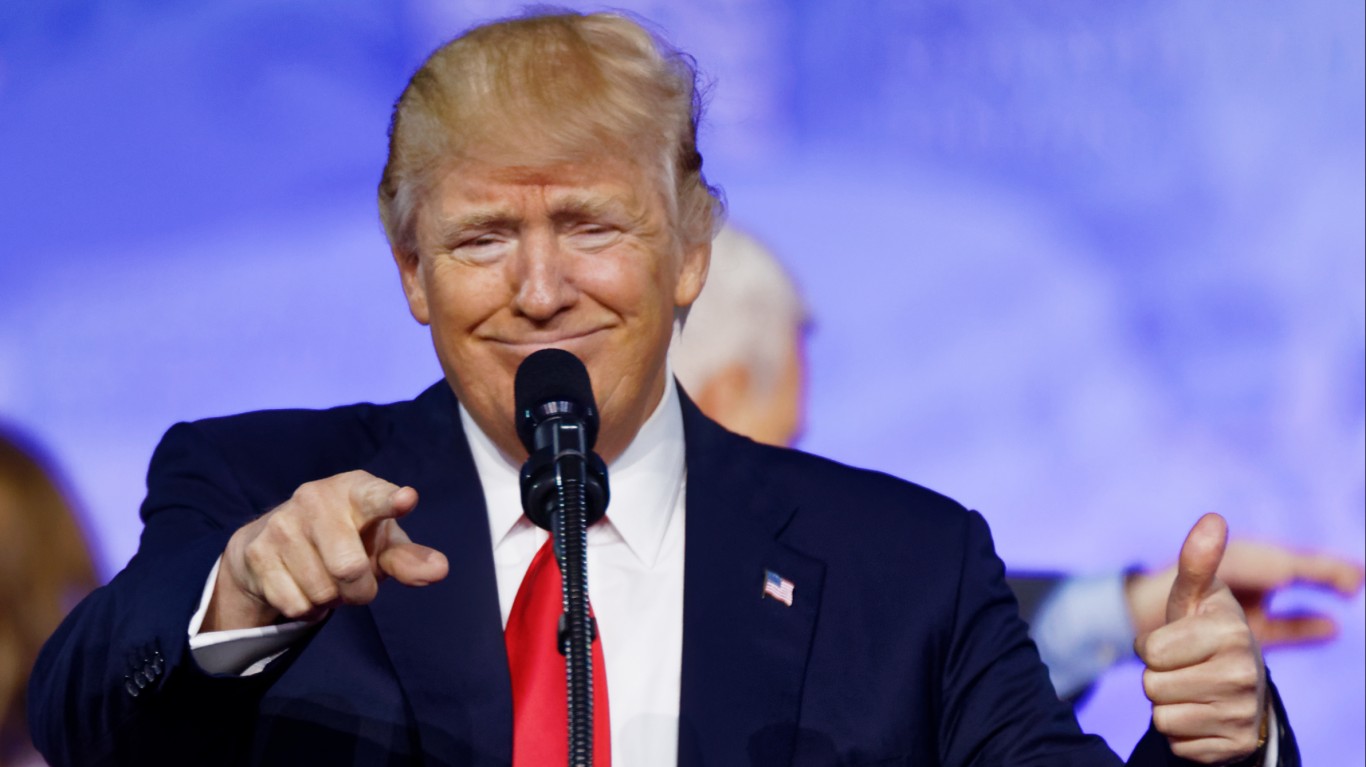
Speaking to a crowd of retirees at The Villages in Florida on Friday, President Donald Trump made a candid concession about the war he launched against Iran on February 28. He told them he had expected worse: a bigger stock-market drop, a sharper spike in oil. “I thought the numbers would be much worse,” he said.
The admission came as the AAA national average for regular gasoline hit $4.45 a gallon on Saturday — a four-year high and roughly 50% above the $2.98 it cost the day before U.S. and Israeli forces began strikes on Iranian nuclear facilities. With the Strait of Hormuz still effectively closed and Iran’s new 14-point peace proposal sitting on his desk, Trump is asking Americans to stay the course.
Trump defends the war
In a 90-minute speech, the president returned repeatedly to his case for action: preventing a nuclear-armed Iran. “We cannot let lunatics have a nuclear weapon,” he told the crowd, framing the war as a non-negotiable security imperative. He described Iran’s military as “decimated,” with no functional navy, air force, or air-defense systems left.
Trump acknowledged the economic cost directly, telling supporters that oil prices had been low before he chose to “upset the apple cart” by going after Tehran. On Truth Social Saturday, he rejected Iran’s latest peace offer, writing that the regime had “not yet paid a big enough price” for 47 years of hostility toward the West.
He also predicted swift relief once fighting ends. Gasoline, he told reporters Thursday, would “drop like a rock” thanks to crude inventories “sitting all over the oceans of the world.”
Why stocks are at record highs anyway
For investors, the puzzle is real. The S&P 500 closed Friday at an all-time high of 7,230.12, capping a roughly 10% April rally — its best month since November 2020. The Nasdaq Composite also hit a record at 25,114.44.
Three forces are propping up equities even as WTI crude trades near $104 a barrel and Brent near $109. First is the AI capital-expenditure boom — Microsoft, Nvidia and Meta delivered earnings that reinforced the trillion-dollar buildout thesis and pulled tech to fresh highs. Second is what traders have nicknamed the “TACO trade” (short for “Trump Always Chickens Out”), a wager that the president will ultimately accept a deal rather than escalate. RBC Capital Markets strategist Helima Croft told CNN the White House has been remarkably effective at persuading parts of the market that the war is nearly over. Third is the Federal Reserve, which held rates at 3.5%–3.75% on April 29 with four dissenters — the most since 1992 — signaling rate cuts could resume if growth softens.
What Wall Street expects next
Forecasts are split. Goldman Sachs raised its Q4 Brent target to $90 and now puts U.S. recession odds at 30%. Citi warns Brent could spike to $150 if the Strait of Hormuz stays shut through June. Moody’s Analytics chief economist Mark Zandi sees “no GDP pickup or job growth this year” even if oil recedes. Former PIMCO CEO Mohamed El-Erian estimates the world has four to eight weeks to reopen the strait before recession risk turns serious. EY-Parthenon’s Gregory Daco pegs 12-month U.S. recession odds at 40%.
The bigger worry on the Street is that the market and main street are pricing in different outcomes. A “TACO trade” reversal — if Iran’s offer is rejected and Trump greenlights additional strikes that CENTCOM Commander Adm. Brad Cooper briefed at Mar-a-Lago last week — could send Brent through $130 and pull equities sharply lower. Conversely, a deal that reopens the strait could trigger one of the largest crude sell-offs of the decade, with Goldman modeling a swift drop toward $75.
For households, the bill is already steep. Brown University’s Costs of War project estimates Americans have paid $29.2 billion in extra fuel costs since February 28 — about $223 per household. Energy Secretary Chris Wright told CNN $3 gas may not return until late 2026 or even 2027, and a Quinnipiac poll found 65% of voters blame Trump at least “some” for the spike at the pump.
The market is betting on a quick resolution. The pump isn’t.









 Top Gaining Stocks
 Top Losing Stocks